Breast cancer
DOI:
https://doi.org/10.3989/arbor.2015.773n3004Keywords:
ductal carcinoma, HER2, lobular carcinoma, treatmentAbstract
The high incidence of breast cancer makes it a major social-health problem in Spain. Over the last three decades, survival rates have improved markedly thanks to the introduction of mammographic screening campaigns and new treatments. Despite the optimistic data, we should not forget that there some patients still relapse after their breast cancer treatment (about 20%), some of whom die from the disease. It is therefore important to continue breast cancer research efforts until a relapse rate of zero is achieved. In this article, we review various aspects of this disease such as its signs and symptoms, diagnosis, chemoprevention, as well as the treatment of localised and metastatic breast cancer.
Downloads
References
Arroyo, A. (2003). Tendencias demográficas durante el siglo XX en Espa-a. En Arroyo, A. (coord.). Fecundidad. Madrid: Instituto Nacional de Estadística, pp. 119 - 162.
Bosch, X. (1998). Investigating the reasons for Spain's falling birth rate. Lancet, 352, 9131, p. 887. http://dx.doi.org/10.1016/s0140-6736(05)60019-0
Ferlay, J., Autier, P., Boniol, M., Heanue, M., Colombet, M. y Boyle, P. (2007). Estimates of the cancer incidence and mortality in Europe in 2006. Annals of Oncology, 18, 3, pp. 581-592.
Fisher, B., Costantino, J. P., Wickerham, D. L., Redmond, C. K., Kavanah, M., Cronin, W. M., et al. (1998). Tamoxifen for prevention of breast cancer: report of the National Surgical Adjuvant Breast and Bowel Project P-1 Study. Journal of the National Cancer Institute, 90, 18, pp. 1371-1388. http://dx.doi.org/10.1093/jnci/90.18.1371
Goss, P. E., Ingle, J. N., Ales-Martinez, J. E., Cheung, A. M., Chlebowski, R. T., Wactawski-Wende, J., et al. (2011). Exemestane for breast-cancer prevention in postmenopausal women. New England Journal of Medicine, 364, 25, pp. 2381-2391. http://dx.doi.org/10.1056/NEJMoa1103507
Hery, C., Ferlay, J., Boniol, M. y Autier, P. (2008). Quantification of changes in breast cancer incidence and mortality since 1990 in 35 countries with Caucasian-majority populations. Annals of Oncology, 19, 6, pp. 1187-1194. http://dx.doi.org/10.1093/annonc/mdn025
Levi, F., Te, V. C., Maspoli, M., Randimbison, L., Bulliard, J. L. y La Vecchia, C. (2007). Trends in breast cancer incidence among women under the age of forty. British Journal of Cancer, 97, 7, pp. 1013-1014. http://dx.doi.org/10.1038/sj.bjc.6603919
López-Tarruella, S., Escudero, M., Martín, M., Jara, C., Guerreo, A., Lluch, A., Santaballa, A., Martínez del Prado, P., Lao, J., Alba, E., Fernández, A., Andrés, R., Llombart, A. et al. (2015). Impact on Survival of primary tumor resection in women with de novo metastatic breast cancer. The GEICAM Alamo I-III breast cancer registry (1990-2001) Cancer Research, 75, P2-13-17.
Martin, M., Llombart-Cussac, A., Lluch, A., Alba, E., Munarriz, B., Tusquets, I., et al. (2004). Estudio epidemiológico del grupo GEICAM sobre el cáncer de mama en Espa-a (1990-1993): proyecto «El Álamo» [Epidemiological study of the GEICAM group about breast cancer in Spain (1990-1993): «El Alamo» project]. Medicina Clínica, 122, 1, pp. 12-17. http://dx.doi.org/10.1016/S0025-7753(04)74126-3
Perou, C. M., Sorlie, T., Eisen, M. B., van de Rijn, M., Jeffrey, S. S., Rees, C. A., et al. (2000). Molecular portraits of human breast tumours. Nature, 406, 6797, pp. 747-752. http://dx.doi.org/10.1038/35021093
Pollan, M., Pastor-Barriuso, R., Ardanaz, E., Arguelles, M., Martos, C., Galceran, J., et al. (2009). Recent changes in breast cancer incidence in Spain, 1980-2004. Journal of the National Cancer Institute, 101, 22, pp. 1584-1591. http://dx.doi.org/10.1093/jnci/djp358
Soerjomataram, I., Pukkala, E., Brenner, H. y Coebergh, J. W. (2008). On the avoidability of breast cancer in industrialized societies: older mean age at first birth as an indicator of excess breast cancer risk. Breast Cancer Research and Treatment, 111, 2, pp. 297-302. http://dx.doi.org/10.1007/s10549-007-9778-2
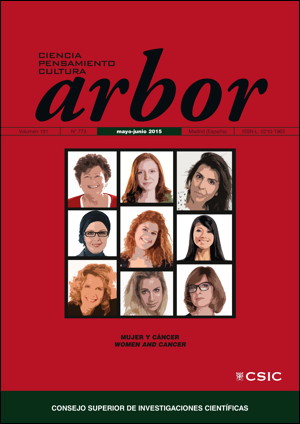
Published
How to Cite
Issue
Section
License
Copyright (c) 2015 Consejo Superior de Investigaciones Científicas (CSIC)

This work is licensed under a Creative Commons Attribution 4.0 International License.
© CSIC. Manuscripts published in both the printed and online versions of this Journal are the property of Consejo Superior de Investigaciones Científicas, and quoting this source is a requirement for any partial or full reproduction.
All contents of this electronic edition, except where otherwise noted, are distributed under a “Creative Commons Attribution 4.0 International” (CC BY 4.0) License. You may read the basic information and the legal text of the license. The indication of the CC BY 4.0 License must be expressly stated in this way when necessary.
Self-archiving in repositories, personal webpages or similar, of any version other than the published by the Editor, is not allowed.