Civil society and rare diseases
DOI:
https://doi.org/10.3989/arbor.2018.789n3001Keywords:
Rare diseases, empowerment, orphan drugs, patient societiesAbstract
Rare diseases are often neglected from both health systems and research. The situation for patients and families is characterized by difficulties not only to receive adequate medical care, but also to get a necessary psychosocial support. However, remarkable positive changes are taking place, such as the growing presence of rare diseases as a group in national and international policies, the changing roles of patients, physicians and researchers and their mutual relations, increasing awareness and social involvement, greater opportunities for dissemination and awareness and the current favourable communications and technological environment. The complexity of these changes and the responsibilities that each group of stakeholders should take in this new framework is controversial and questions of an ethical nature are arising. These are often difficult to answer and the role adopted by the different agents can be explained by their pressing needs.
Downloads
References
Anderson, M., Elliott, E. J. y Zurynski, Y. A. (2013). Australian families living with rare disease: experiences of diagnosis, health services use and needs for psychosocial support. Orphanet Journal of Rare Diseases, 8, 22. https://doi.org/10.1186/1750-1172-8-22 PMid:23398775 PMCid:PMC3599672
Avellaneda Fernández, A., Layola, M., Izquierdo Martínez, M., Guilera, M., Badía Llach, X. y Ramón, J. R. (2007). Impacto sociosanitario en pacientes con enfermedades raras (estudio ERES). Medicina Clínica, 129 (17), pp. 646-651. https://doi.org/10.1157/13112096
Ba-ón Hernández, A. M., Fornieles Alcaraz, J., Solves Almela, J. A., Rius Sanchis, I. (coords.) (2011). Desafíos y estrategias comunicativas de las enfermedades raras: la investigación médica como referente. Estudio cuantitativo-discursivo de la prensa escrita impresa y digital espa-ola (2009-2010). Valencia: Centro de Investigación Biomédica en Red de Enfermedades Raras CIBERER. Disponible en http://www.orphanet-espana. es/national/data/ES-ES/www/uploads/ investigacionmedica.pdf
Editorial: Making rare diseases a public-health and research priority [Editorial]. The Lancet, 371 (9629) (14 de junio de 2008), p. 1972.
Henderson, S. L., Packman, W. y Packman, S. (2009). Psychosocial aspects of patients with Niemann-Pick disease, type B. American Journal of Medical Genetics A 149 (11), pp. 2430-2436. https://doi.org/10.1002/ajmg.a.33077 PMid:19877061
Huete García, A., Díaz Velázquez, E., Díaz García, E. Sola Bautista, A., Petisco Rodríguez, E. y Lara Gonzalo, P. (2009). Estudio sobre situación de Necesidades Sociosanitarias de las personas con Enfermedades Raras en Espa-a. Estudio ENSERio. Madrid: Federación Espa-ola de Enfermedades Raras FEDER. Disponible en https://enfermedades-raras. org/images/stories/documentos/Estudio_ENSERio.pdf
Weely, S. van y Leufkens H. G. M. (2004). Orphan diseases. En: Priority Medicines for Europe and the World. A Public Health Approach to Innovation. Ginebra: World Health Organization, pp. 95-100. Disponible en http://www.who. int/medicines/areas/priority_medicines/BP6_19Rare.pdf
Recursos de Internet
Kaplan, W. y Laing, R. (2004). Priority Medicines for Europe and the World. Ginebra: World Health Organization. Disponible en http://apps.who.int/iris/bitstream/ handle/10665/68769/WHO_EDM_PAR _2004.7.pdf;jsessionid=D110B2A26E61 655CF14FA6D2C3A4C5BA?sequence=1
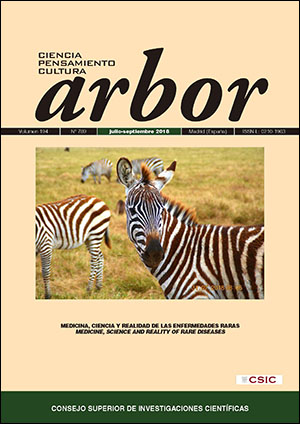
Published
How to Cite
Issue
Section
License
Copyright (c) 2018 Consejo Superior de Investigaciones Científicas (CSIC)

This work is licensed under a Creative Commons Attribution 4.0 International License.
© CSIC. Manuscripts published in both the printed and online versions of this Journal are the property of Consejo Superior de Investigaciones Científicas, and quoting this source is a requirement for any partial or full reproduction.
All contents of this electronic edition, except where otherwise noted, are distributed under a “Creative Commons Attribution 4.0 International” (CC BY 4.0) License. You may read the basic information and the legal text of the license. The indication of the CC BY 4.0 License must be expressly stated in this way when necessary.
Self-archiving in repositories, personal webpages or similar, of any version other than the published by the Editor, is not allowed.